Safety over EtherCAT (FSoE) is a functional safety communication protocol that enables safety-related data to be transmitted through EtherCAT-based industrial networks. By combining standard automation control and safety communication within the same network infrastructure, FSoE supports efficient and flexible machine safety systems.
In motion control applications, FSoE-compatible safety encoders provide safety-related position and speed feedback to compatible safety controllers, helping machinery operate within defined safety parameters.
Safety over EtherCAT, also known as FailSafe over EtherCAT, is designed to provide secure and reliable communication between safety-related devices in industrial automation systems.
The protocol operates using the black channel principle, where safety data is transmitted over the existing communication network with additional protective measures to detect transmission errors.
These mechanisms help identify:
Corrupted or missing safety data
Communication faults and interruptions
Incorrect communication partners
Delayed or unexpected messages
Errors that require a defined safety response
FSoE is standardised under IEC 61784-3 and is suitable for safety communication applications up to Safety Integrity Level (SIL) 3.
EtherCAT is widely used in industrial automation because of its fast, deterministic communication and precise motion control capabilities. However, standard EtherCAT communication does not independently provide the safeguards required for functional safety.
FSoE introduces a dedicated safety communication layer, allowing safety-related information to be exchanged alongside normal machine control data.
This supports safety functions such as:
Safe position and speed monitoring
Safe direction monitoring
Safe motion control
Safe stopping functions
Integrating safety communication into an existing EtherCAT network can simplify system architecture, reduce the need for separate communication infrastructure and support coordinated machine safety functions.
Although closely related, EtherCAT and FSoE serve different purposes.
EtherCAT is a high-performance industrial Ethernet protocol used for real-time communication between controllers, drives, sensors and other automation equipment.
Safety over EtherCAT (FSoE) provides an additional functional safety communication layer, allowing safety-related information to travel through the same network.
FSoE uses protected safety data containers, incorporating mechanisms such as checksums, connection identification and timing supervision to detect communication errors.
This approach enables standard control data and safety information to share the same infrastructure without relying on the underlying network to provide the required safety protection.
Encoders play an important role in functional safety applications by providing information about machine position, speed and movement.
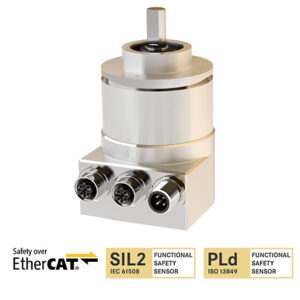
An FSoE-compatible safety encoder transmits safety-related motion data to a compatible safety controller, supporting the monitoring of machine operation against predefined limits.
Depending on the encoder and system configuration, this can include:
Absolute position feedback
Speed monitoring
Direction of rotation
Movement detection
If an unsafe operating condition or communication fault is identified, the safety controller can initiate the appropriate response according to the machine’s safety design.
Important: The achievable safety level and supported functions depend on the certification and specifications of the encoder, controller and complete safety system.